Table of Contents
- The First Misconception: These Cloud Platforms Are “Similar.”
- Where AWS Still Leads
- Why Azure Wins More Deals Than People Admit
- GCP’s Advantage Isn’t Size, It’s Design
- Migration Reality
- The Cost Myth That Keeps Repeating
- Multi-Cloud Isn’t Strategy, It’s Reality
- What Actually Drives the Right Decision
- A Practical Perspective From the Field
- What This Means for Your Cloud Strategy
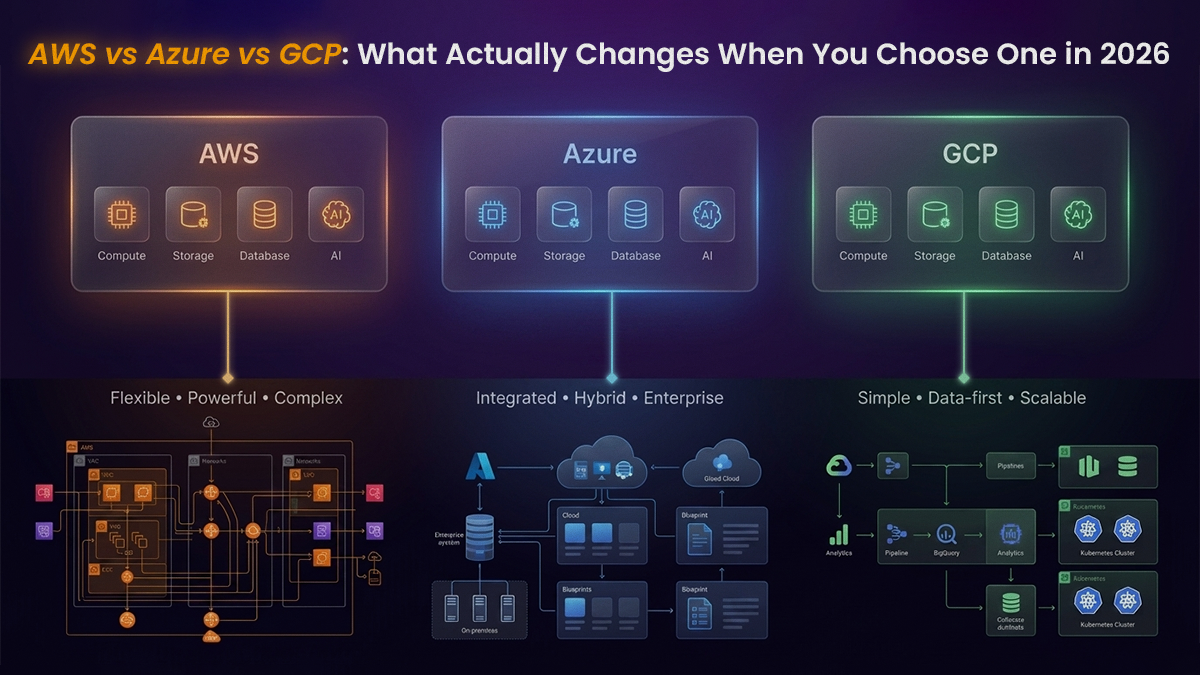
The decision process between AWS, Azure, and GCP is not a matter of having the most complete list of features available nowadays. It looks the same on paper. Computing? Got it. Storage? Got it. Network, databases, AI capabilities, everything is there. However, when you dive into development, scaling, and migration, the differences become very obvious almost immediately. And not in an obvious way. Differences will be seen in traffic management, deployment processes, access control, and finally… in your monthly bill after six months.
Based on experience, this decision does not come down to a feature comparison. This comes down to architecture, identity management, operations complexity, and the practical implementation of it all. Let’s see what this means.
The First Misconception Is That These Cloud Platforms Are “Similar”
At first glance, it may look good. However, once you try to implement these systems, you will understand where the differences are. Take, for instance, the implementation of authentication and authorization. In AWS, IAM works with policy-based access control. You simply need to create policies for all users, roles, and applications; however, things become complicated if you need to grow your business.
Azure uses Microsoft Entra ID, previously called Azure Active Directory. All operations use role-based access control (RBAC) throughout all the resources. Finally, IAM on GCP looks cleaner; there might be some limitations when implementing specific solutions. These small details may seem small at first; however, once implemented, they affect how secure, maintainable and understandable your system is. .
Where AWS Still Leads
The “best” depends on you, but AWS never blocks you. If your project involves a unique configuration, integration, or an advanced managed service, AWS will certainly offer that. Still, AWS network infrastructure remains the biggest of all, and its significance becomes apparent in building an actual application rather than designing a prototype. This flexibility comes with a great cost.
It requires significant skills and experience to configure and manage AWS Networking, VPC, Routing, NAT Instances, PrivateLink, and other similar services. A minor mistake can result in poor performance and extra charges. The problem is that AWS does not facilitate tracking costs.
|
AI-Powered Development Insights for Modern Engineering Teams Accelerate your software delivery with intelligent engineering solutionsClarityTech Labs helps organizations adopt next-generation AI development tools, modernize legacy systems, and implement scalable engineering practices — from strategy to execution. Enterprise-ready solutions • Fast onboarding • Proven expertise |
Why Azure Wins More Deals Than People Admit
What makes Azure successful goes beyond what technology Azure brings to the table. Compatibility becomes the key factor here. For example, if your firm has been using other software products that are from Microsoft, Azure would be an easy option for you.Moreover, Azure is good at handling hybrid cloud infrastructure management. Thanks to the use of tools like Azure Arc, it gets much easier to integrate on-premises and cloud technologies. Sometimes, some issues arise. First of all, developers may face issues related to product performance, nomenclature issues, portal latency, and various other issues. However, in the case of enterprise software, this works perfectly well.
GCP’s Advantage Isn’t Size, It’s Design
The approach of GCP is completely different from the above two. GCP is opinionated in nature. Rather than offering too many services, it offers just a few things in a very good way. In BigQuery, there is a new way to perform analytics where you can query data without any worry about cluster management. With Google Kubernetes Engine (GKE), Kubernetes looks a lot simpler as compared to other cloud service providers. You will find it much more natural to work on machine learning jobs in this cloud ecosystem. It is very opinionated, yet if your requirement matches its opinion, then GCP is going to be easy on you.
Migration Reality
Migration is easier described than done. Everyone knows how to migrate. But not everyone talks about what they face during the process.
Here’s what is often encountered:
- Mapping services is complicated
Not only do you have to rename services. The applications that run on Google Compute Engine work differently from those running on Amazon EC2. Reengineering will be needed.
- Data migration takes both time and effort
Moving substantial volumes of data takes quite some effort and time. This step is always overlooked.
- Costs for infrastructure appear at the last minute
Cost for transferring and storing all of that information appears only at the final stage and tends to be a shock.
- There’s still potential for downtime
Despite the use of replication technologies, the transition point may still lead to unexpected downtime because of misconfiguration.
- Your people slow you down
People from your team need to have a profound understanding of the environment to which you are migrating. Otherwise, even simple tasks may turn out to take lots of time.
The Cost Myth That Keeps Repeating
All companies tend to embrace the cloud and immediately see savings in their bills. It doesn’t work like that. Pricing discrepancies between AWS, Azure, and GCP for similar services are usually within a range of 5% to 15%. Everything comes down to your operational effectiveness.
You end up spending more due to:
- Infrastructure idleness
- Poor scalability
- Underused storage
- Lack of transparency
There’s nothing wrong with how much you pay for the cloud. Without strong cost discipline, switching clouds will not help you. FinOps beats cloud choice hands down.
Multi-Cloud Isn’t Strategy, It’s Reality
Multi-cloud is not often designed by teams from day one. On the contrary, it happens over time, with one team adopting AWS to create an infrastructure, another using GCP for analytics, Azure for integration, and suddenly there are three clouds in place.
The trouble does not lie in working with multiple clouds.
- The difficulty lies in treating them all the same.
- Observing becomes challenging.
- Identity management becomes complex.
- Cost management becomes decentralized.
To put it simply, multi-cloud without proper governance makes things worse.
What Actually Drives the Right Decision
The “perfect” cloud solution would depend solely on your circumstances.
Consider these factors when making your decision:
- Your Existing Environment
If you’re a company with a heavy investment in the Microsoft ecosystem, then Azure is probably a natural fit. Going against that doesn’t make much sense.
- Your Team’s Expertise
If you have a team with extensive experience with AWS workloads, shifting to GCP is not going to yield better outcomes; it might even backfire.
- Your Workload
Workloads that are highly data-intensive suit GCP very well. Applications geared toward enterprises suit Azure. Complex and customized applications suit AWS.
A Practical Perspective From the Field
The success of cloud computing doesn’t lie in selecting the right vendor; it lies in the design and operation strategy that you apply to it. The firms that have succeeded greatly in applying it are those who use architecture, automation, and operations extensively. Cloud, for such organizations, symbolizes an ongoing process of improving processes and not just an implementation. This is where the expertise truly shows its power. At ClarityTechLabs, we prioritize building systems that create clean architectures, automation first workflows and models that don’t break.
What This Means for Your Cloud Strategy
The three technologies are highly effective. The three technologies can be used to develop scalable architectures. Nevertheless, they shape how your architecture will evolve. You might compare all three by their functionality, and then you won’t reach the point. But if you look at them from the point of view of architecture, team skills, and operation, you’ll be able to make the right decision. That is because in the end, the success of your cloud doesn’t depend on the best technology but on how it is used properly.