Agentic AI vs. Generative AI: The Difference and Why It Matters
Within the ever-changing digital transformation environment, organizations are moving towards progressive modes of artificial intelligence (AI) to base their competitive edge on. The two most discussed are agentic AI and generative AI. Even though they can be applied interchangeably, they operate in varying operational capacities and provide different value to organizations. When it comes to providing intelligent automation, sophisticated analytics, and creative solutions to our clients, it is quite simple to learn and leverage both in the case of a progressive technology company.
In this case, we will unpack the fundamentals of generative AI and agentic AI and contrast one to the other, and how the two notions can be applied to enable insight, creativity, and automation in business.
What Is Generative AI?
Generative AI programs generate new content: text, images, audio, code, or even structured data. These methods are based on big data and can generate results that are either similar to humans or completely novel. For instance, the case of an AI-powered content tool can be widely recognized that gets blog written, illustrations for marketing produced, and applications coded.
Key Highlights of Generative AI
- Creation of content at scale: Writing marketing copy drafts, creating a visual or script draft, etc.
- Rapid prototyping: Creation of design prototypes, user interface tests, or data visualization.
- Enhancing creativity: Since marketing and digital folks are creators, it is good to provide them with new ideas to improve and implement.
- Repetitive generation tasks automation: Liberating human teams to concentrate on strategy and innovation.
In short, generative AI has made it possible for digital agencies to produce creative assets in a manner that is fast, flexible, and iterative.
What Is Agentic AI?
Instead of just building things, some AI takes on jobs—planning how to do them, finding what it needs, talking to people or other programs, and then getting it done without constant help. It’s like giving AI the power to act on its own, making choices and learning as it goes.
Key Highlights of Agentic AI:
- Figuring out what to do next: Picking a path considering goals alongside what’s happening around you.
- The ability to initiate contact: With programs, people, information, or anything else—without being asked.
- Keeping work moving: Seeing what’s done and where things stand, and also being able to shift gears when needed.
- Feedback learning: When things don’t go as planned, we adjust how we act so results improve. It’s about modifying conduct to get different outcomes.
Imagine a helpful computer program—a virtual team member—capable of handling parts of work on its own. It’s useful when businesses want to do things differently.
Side-by-Side Comparison of Agentic AI and Generative AI
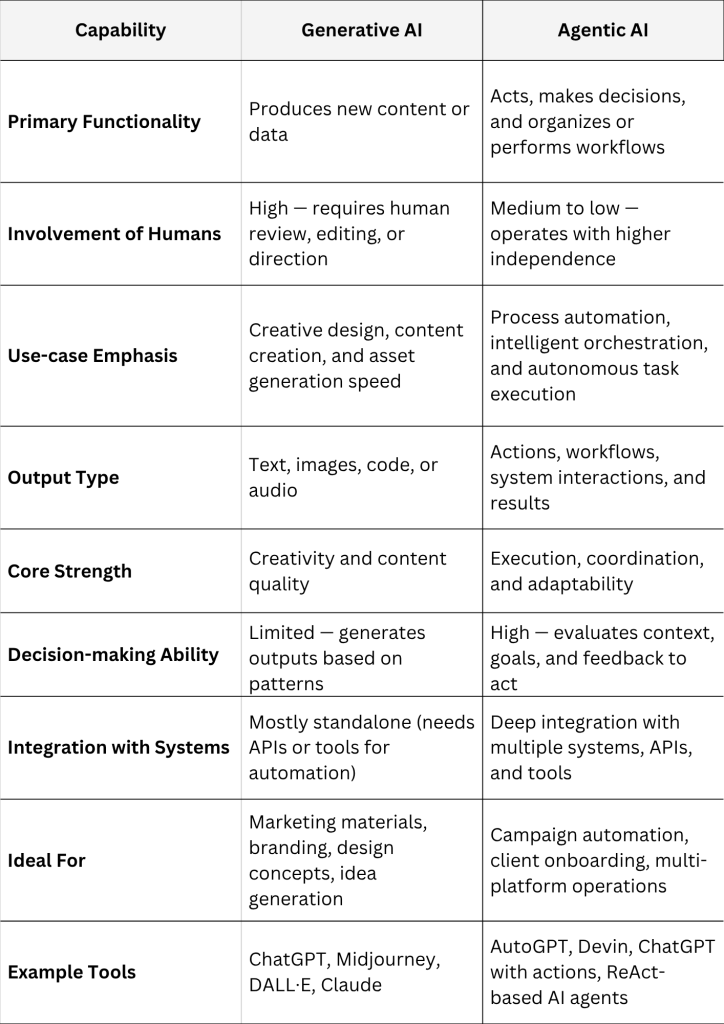
In the case of a digital service provider such as Aozata, both paradigms apply: the generative AI raises the level of the production of creative content; the agentic one raises the level of operational efficiency and responsiveness of the systems.
Real-World Examples of Agentic AI and Generative AI
To further compare the difference between agentic AI and generative AI in practice in technical applications, we will examine some real-life applications in industries:
Marketing Campaign Management
A language model like GPT will write 50 variants of the ad in advance, generating headlines, images, and text itself, depending on the tone and the intended audience. This is where an AI-based campaign agent is in charge of continually tracking the performance of ads on Google Ads and Meta, automatically redistributing and stopping non-performing ads without requiring human intervention.
Software Development
A code-generation model, such as GitHub Copilot, is a Python function model that produces snippets or full functions on developer requests. An autonomous DevOps agent can identify bugs in the production log history, roll back malfunctioning deployments, and send notifications to the engineering team.
Customer Support Systems
A chatbot is a natural language response generator that responds to queries posed by the customer in context. A virtual support agent reviews ticket queues, sorts priority cases, escalates challenging cases, and closes resolved tickets—all automatically.
Data Analytics and Insights
It uses data visualization to generate dynamic dashboards and visual explanations of complex data sets. The motivated data agent gathers data across various databases, cleans it, detects anomalies, and feeds insights directly into the decision-support system.
These examples help distinguish these two types of artificial intelligence: generative AI generates, and agentic AI operates. The two combined put businesses in a position to create smart systems that are capable of not only thinking and generating, but also making and acting.
Considerations to Make When Adopting Agentic AI or Generative AI
Data Quality and Governance
Clean and well-organized input data and good governance form the foundation of generative and agentic AI. In agentic systems specifically, proper data plays a crucial role in the correct initiation of decisions, workflow, and assessment of results.
The Ethical Oversight and Human-in-the-Loop
Generative AI can produce content that needs to be checked by humans to determine that it is correct, of the right tone, brand-neutral, and not biased. As agentic AI agents are likely to commit inadvertent automation, some delimiting is required, along with escalation paths and oversight.