There is a lot that goes into a B2B deal. Every step of it matters. If a prospect has friction at any point during the purchase journey, there are more chances they will walk away.
The very obvious problem is that most B2B sellers do not have the time to deliver a personalized experience that B2B buyers expect. Sales reps are bombarded with heavy, tedious tasks. This leaves them with very little time for them to build relationships and close deals. So, more organizations are turning to AI sales agents to bridge these gaps. We will take a closer look at what AI sales agents are and how they have become an important tool for many modern businesses.
What Is an AI Sales Agent?
This is a tool that uses AI to perform and help with the selling tasks. They combine the technology just like LLMs to work instead of sales teams. It requires very minimal human intervention and is used to save time and improve customer experiences.
AI agents can help is various areas like:
- Lead qualification
- Scheduling meetings
- Communicating with leads and responding to their queries on the spot
- Ensuring precision when recording data in sales applications
- Evaluating sales calls and suggesting appropriate follow-up actions
Unlike older automation approaches that work on pre-defined rules, AI-driven sales assistants have the ability to read and comprehend situations based on emails, chats, and CRM interactions. They can also determine customer intent, sentiment, and what to do, and automate action across multiple applications.
Types of AI Sales Agents
AI agents can be different types, depending on the sales funnel phase in which they are used.
Assistive AI Sales Agents
These agents support your sales team without actually replacing them. Their main work is research, account summaries, CRM updates, and call notes. They are very low risk and easier to implement, which is best suited for smaller companies. For example, they help you draft a pitching email, but the seller should review the email before sending it.
Autonomous AI Sales Agents
They act independently and complete the entire process without the involvement of a sales rep. The AI agent can interact with prospects and schedule meetings with them on their own.
Specialized AI Sales Agents (Use-Case Based)
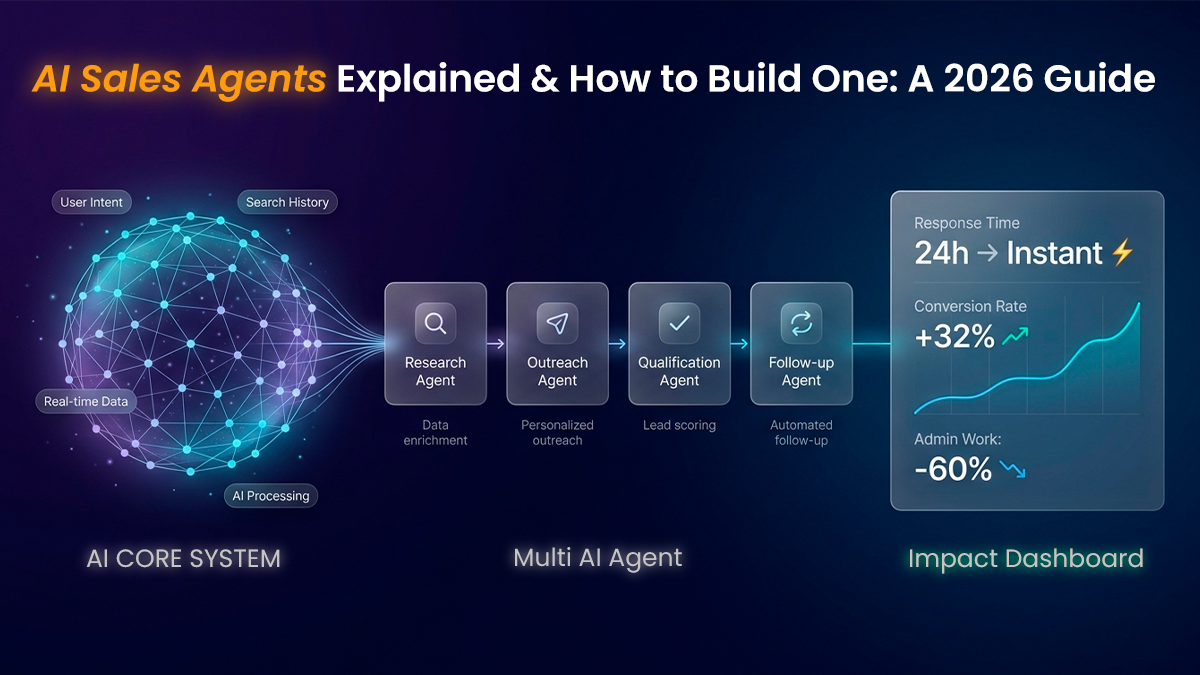
Instead of a single agent doing everything, the team deployed multiple agents. This multi-agent approach is becoming very popular in 2026.
Key Benefits of AI Sales Agents
When used strategically, AI sales agents give you value across the organization.
Instant Lead Response
Lead response in real-time will increase conversion rates. It makes sure the leads are contacted in time without missing anything.
Faster Qualification
The tasks that used to take days now are done in just hours through real-time data analysis.
Reduced Admin Work
Reps will have more time to build relationships and close sales than update CRMs.
Scalable Personalization
They are able to customize their approach without losing their relevance.
Real-World Use Cases of AI Sales Agents
AI sales representatives can be used throughout the funnel:
- Lead qualifying (inbound): Immediately qualify leads
- Lead generation (outbound): Qualify leads for outbound campaigns
- Meetings: Get rid of email ping-pong
- Follow-up: Re-energize dead deals automatically
- Sales ops: Ensure accurate data and workflow compliance
How to Build an AI Sales Agent (Step-by-Step)
At Claritytechlabs, there is one mistake that we see repeatedly occurring among teams. That is the attempt to automate everything all at once. This never works, and the winners are always those who have to build their systems from the ground up. This is how we build our AI-based agents from scratch.
Step 1: Choose a Clear Use Case
Always start by narrowing down your scope.
Step 2: Connect Your Data Sources
The AI sales agents must be able to receive real-time, accurate data. In addition, they require access to CRM solutions, marketing tools and different channels of communication. Our AI sales agents are highly important here as they facilitate integration between different applications.
Step 3: Define Instructions and Guardrails
Here comes the step which determines whether you are going to succeed or fail.
We identify:
- What the agent should do.
- What it should not do.
- When the conversation needs to be passed on to humans.
Guardrails makes sure the agent follows your guidelines, messaging standards, and compliance rules.
Step 4: Enable Actions and Integrations
A true AI sales representative does not just react but acts. Our agents are built to be able to:
- Send targeted emails
- Automatically update CRM
- Assign tasks to your team.
- Schedule meetings without negotiations
That’s how AI becomes your income generator.
Step 5: Test With Real Scenarios
Prior to the actual deployment, we subject all agents to rigorous testing as follows:
- Testing for edge cases that occur in real-life situations
- Testing for wrong or incomplete inputs
- Tone, accuracy, and effectiveness in communication
The principle here is very straightforward – reliable first, scalable later.
Step 6: Deploy Gradually
A total roll-out is definitely not done right away because we:
- Start deploying by process or department:
- Carefully observe results
- Scale out based on success.
This reduces risks while building early confidence.
Step 7: Monitor and Optimize
Scaling is only half of the equation. We keep track of:
- Average response time
- Conversion rates
- Time saved by each sales rep
Using this information, we optimize the agent.
Best Practices for AI Sales Agents
From what we have seen in our own applications, there are some key concepts that always produce successful outcomes. Having people around to make key decisions leads to better judgments when it really counts, and at the same time, having no over-automation at an initial stage makes sure that the team remains in control as the system grows up. Also, it is vital to maintain clean and organized data in all systems in order to have accurate results, along with defining the revenue targets for each AI agent. Finally, continuous improvements through monitoring are a must-have. What causes failure in the majority of cases is automation with no strategy.
The Future of AI Sales Agents
What we’re striving for, and we’ve started implementing at ClarityTechLabs, consists of using a more collaborative approach to AI. Instead of building a generalist agent that does everything, we build specialists focused on conducting research, reaching out, and qualifying leads. Once they are working in a cohesive sequence, you can almost think of the whole thing as a properly functioning sales team.
Sales teams that are able to use AI effectively and achieve good results aren’t those rushing headfirst into this innovation in hopes of success. On the contrary, they’re the teams that start small, identify practical applications for using AI, establish necessary guardrails, and scale when it makes sense to. The benefit here is that by applying such an approach, not only will you be able to reduce your workload, but you’ll generate revenue through pipelines.