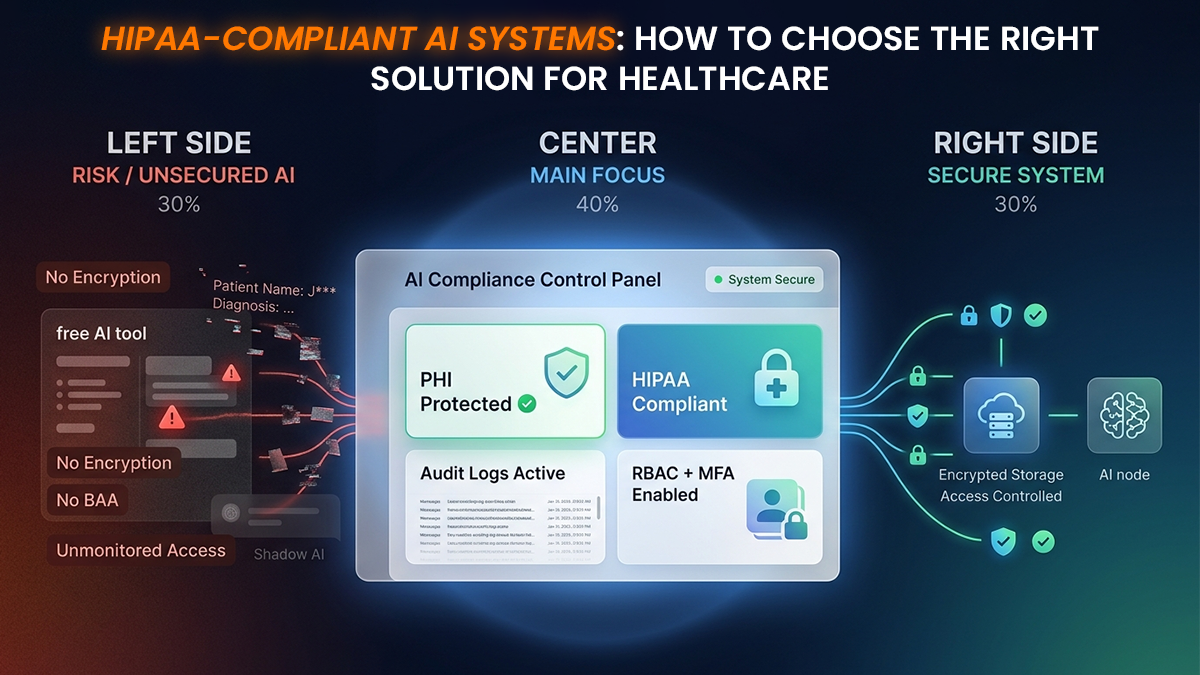
HIPAA-Compliant AI systems are revolutionizing the healthcare industry through the automation of administrative processes. Consequently, HIPAA becomes very significant for any technology involving PHI(Protected Health Information). The integration of AI in health operations has turned out to be a crucial part. It is, therefore, vital for all healthcare institutions to have knowledge of the HIPAA regulations applicable to modern AI systems. In this blog, I’ll break down the requirements and features that define HIPAA, while also giving you a clear framework to help your healthcare organization evaluate vendors and get trusted platforms.
What Makes An AI System HIPAA-Compliant?
HIPAA compliance is not just a simple checklist you can cover. It is a framework that has technical and administrative safeguards. You need to look for:
- Business Associate Agreement (BAA) – The Vendor must sign a BAA, that binds the vendor to HIPAA guidelines.
- Encryption (at rest and in transit) – The privacy of the patient and other medical information needs to be safeguarded through stringent industry norms.
- Access controls (RBAC, MFA) – Your platform needs to offer RBAC, multi-factor authentication, and session timeout facility.
- Audit logs and monitoring – HIPAA asks the system to monitor and log all the accesses involving PHI.
|
AI-Powered Development Insights for Modern Engineering Teams Accelerate your software delivery with intelligent engineering solutionsClarityTech Labs helps organizations adopt next-generation AI development tools, modernize legacy systems, and implement scalable engineering practices — from strategy to execution. Enterprise-ready solutions • Fast onboarding • Proven expertise |
The Real Risks Of AI In Healthcare
New challenges and updates have come in. This is your differentiation layer. Focus on modern risks:
PHI exposure via Generative AI prompts – Today’s language models can memorize sensitive data and track prompt input.
Employee use of Shadow AI tools like ChatGPT – Employees could be using ChatGPT and compromising sensitive data.
Not Every AI System Carry The Same Risk
Not all AI systems have the same risk. HIPAA compliance is an effort from your side as well as the vendors that you trust. When you hire a good third-party vendor, they deliver you a tool that is compliant and handles all the patient data securely.
While it is the vendor’s responsibility to ensure the data is protected, it is the organization’s responsibility to configure and use it properly. If there are misconfigurations and improper workflows, then it is your responsibility. This is the reason BAA is very important. It makes sure all the parties involved uphold their end of the bargain. When it comes to Clarity Tech Labs, the emphasis is not only on developing artificial intelligence solutions. The idea behind this strategy is coming up with solutions that suit your processes in accordance with the regulations and thus minimizing your risk potential, both at platform level and during the process of implementation of such solutions.
Types Of HIPAA-Compliant AI Systems
In selecting an AI tool that complies with HIPAA, it will be helpful to know the three types of HIPAA-compliant AI tools that you can choose from. These include managed HIPAA platforms, cloud platforms, and no-code AI. The best use of a managed HIPAA platform is when you are looking for a ready-made platform, which has all the required tools embedded in it, so that one can start using the platform right away. However, cloud computing platforms such as Amazon Web Services (AWS), Google Cloud Platform (GCP), and Microsoft Azure offer computing power and flexibility, but they also require special expertise for configuring them for security and data management purposes. No-code or workflow AI is another kind of AI software that offers a platform where one can create applications without having to code. It can be useful for processes such as document management and registration of patients without creating a specific application for it. When you need an AI solution, which is according to your process and workflow, then you have to build software for yourself with our assistance.
How To Choose The Right Platform
When you are choosing a HIPAA-compliant AI platform, it comes down to 4 important checks.
- Start with BAA
No BAA = immediate disqualification. If the vendor is not willing to sign one, it is not worth the risk.
- Understand Data Flow
Where does PHI go? Is it shared externally? You need to get clear visibility on how the data is moving through your system. If there is no transparency, it is a major red flag.
- Validate Security Controls
You need to look for a very strong encryption at both rest and transit. You need to have information on encryption, access restrictions, and detailed log audits.
- Check AI-Specific Safeguards
When there is AI, there are additional risks. The system should ensure that there is prompt filtering so that any leakages do not occur. It must be ensured that your data is not used for training any model and the output must also be checked.
These help you choose the best platform, not just on paper but also in practice.
Build Secure Systems With AI In Healthcare
Artificial intelligence in the healthcare industry is now very important, yet how you implement it will determine its potential to be either beneficial or problematic. While compliance may seem like just another mandatory factor that must be considered, it is actually what makes your organization’s relationship with AI productive and safe. When choosing the most appropriate AI platform, do not base your decision on the number of its capabilities, but rather on its ability to address risk management issues at all levels.